Credit management configuration for staff
Credit management establishes credit limits for organizations that can be used for purchasing eligible services. The credit can optional be sub-allocated to projects and used in cost policies.
Users with staff role can allocate credit to organizations. Open Administration in the sidebar, then Organizations & compliance → Credits & cost policies. The Credits tab lists the credits already assigned; the Cost policies tab holds the organization cost policies.
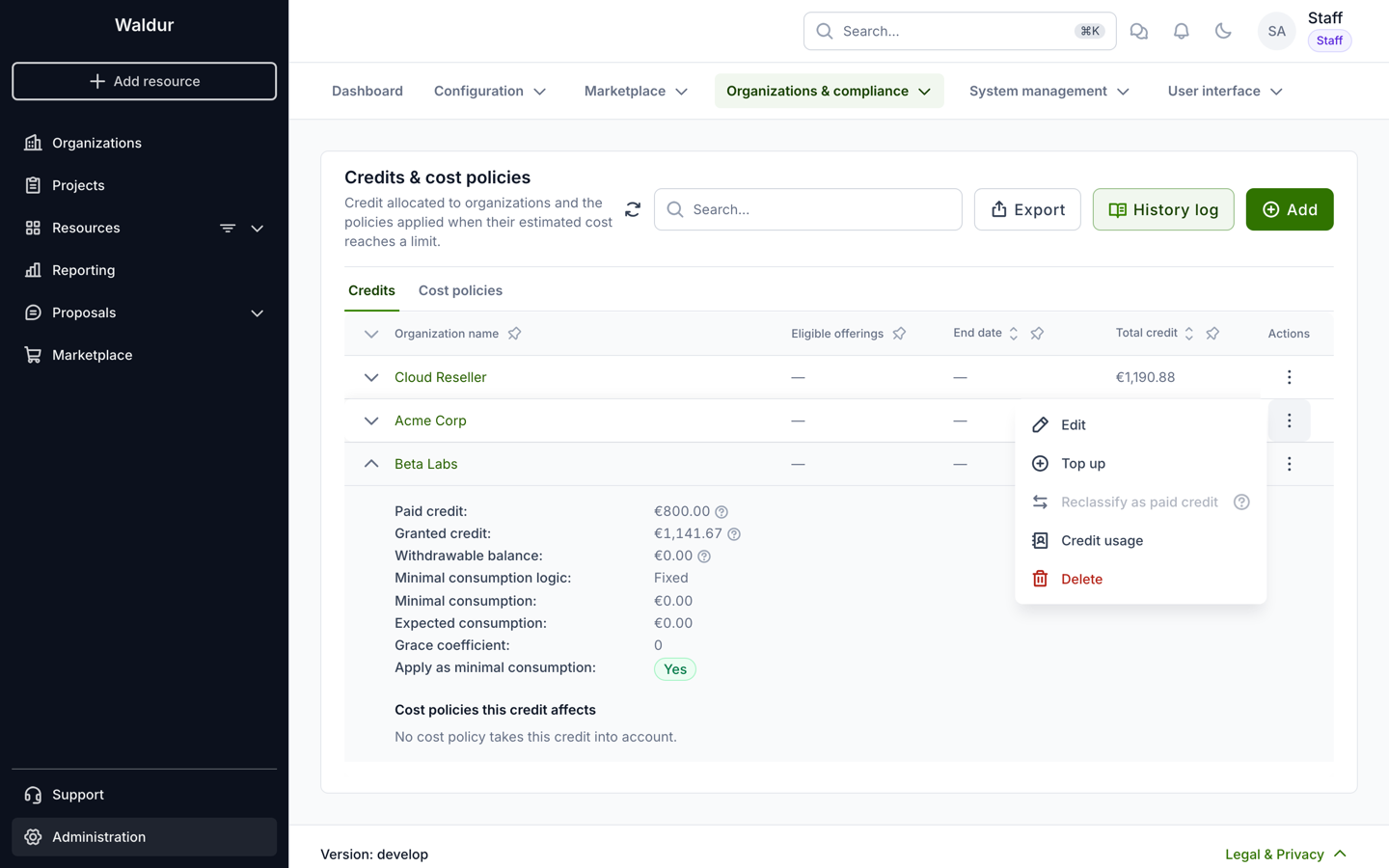
To assign a credit, click Add. A dialog opens with these fields.
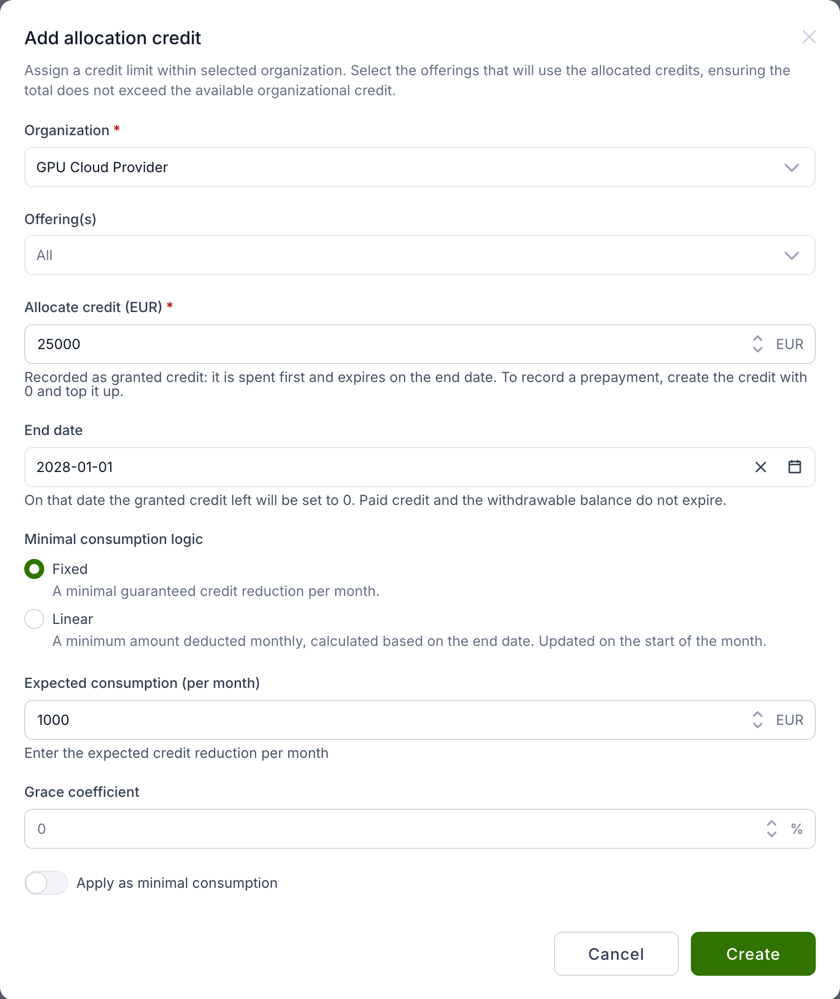
- Select an organization to which you would like to assign credits.
- Select the offerings the credit may be spent on. Leave this empty to allow all offerings — an empty list means unrestricted, not "none". Cost on any other offering is invoiced normally and is never drawn from the credit.
- Set the credit value. This is the total value that the organization will be able to spend, recorded as granted credit (see below).
- Optionally set an end date. It must be the first day of a month. At the first monthly billing run after that date, the remaining granted credit is set to 0, and minimal consumption is no longer charged; prepaid and earned credit (see below) do not expire.
-
Minimal consumption logic defines, how minimal monthly consumption is calculated:
- Fixed means that it is possible to define minimal monthly value and overall credit will be reduced by the monthly value, even if the usage has been less than minimal consumption.
- Linear means that by setting the end date, the granted credit will be divided evenly across the period until the end date and the credit will be reduced monthly by the calculated value even if the consumption is less than the calculated value.
-
Expected consumption is the monthly amount for the fixed logic. It is only charged as a minimum when Apply as minimal consumption is on. The Grace coefficient lowers that minimum by a percentage: with an expected consumption of 1 000 and a grace coefficient of 10 %, at least 900 is deducted each month. In the month of the end date, the full expected consumption is deducted. The minimum is deducted only from granted credit, so it is capped by what is left of it; prepaid and earned credit (see below) are never taken by it.
- If all set, click Create.
Warning
Restricting the offerings is not the same as excluding cost from the organization. Resources on offerings outside the list are still bought and still invoiced — the credit simply never covers them. Because that cost is never compensated, it counts towards cost policies immediately, while the credit balance still looks untouched.
Granted, prepaid and earned credit
An organization's credit is one balance, made of three kinds of money:
- Granted — credit allocated by staff, as in the dialog above. It is a discount: it expires on the end date and does not count towards an affiliate fee.
- Prepaid — a customer's prepayment, for example a bank transfer, recorded by staff as a top-up on the organization's credit. Waldur shows it as Paid credit. It is the customer's money: it never expires, and invoices paid from it still earn the affiliate fee.
- Earned — affiliate fees and other earnings. Only this part is withdrawable.
Usage spends granted credit first, then prepaid, then earned. Top-ups and reclassifications are recorded in the credit-transaction ledger and the organization's event log with their comment. Editing the total credit can lower it by no more than the granted credit left: prepaid credit is lowered by reversing a top-up, and earned credit by adjusting the withdrawable balance.
Viewing the split
In the Credits list, expand an organization's row to see its Paid credit, Granted credit and Withdrawable balance. The row's Actions menu holds Top up and Reclassify as paid credit next to Edit, as in the list at the top of this page.
The same figures are on the organization's own page: open the organization, select the Edit tab, then Credit management. Staff have a button next to each figure: + next to Paid credit tops it up, ⇄ next to Granted credit reclassifies it, and the pencil next to Withdrawable balance adjusts it.
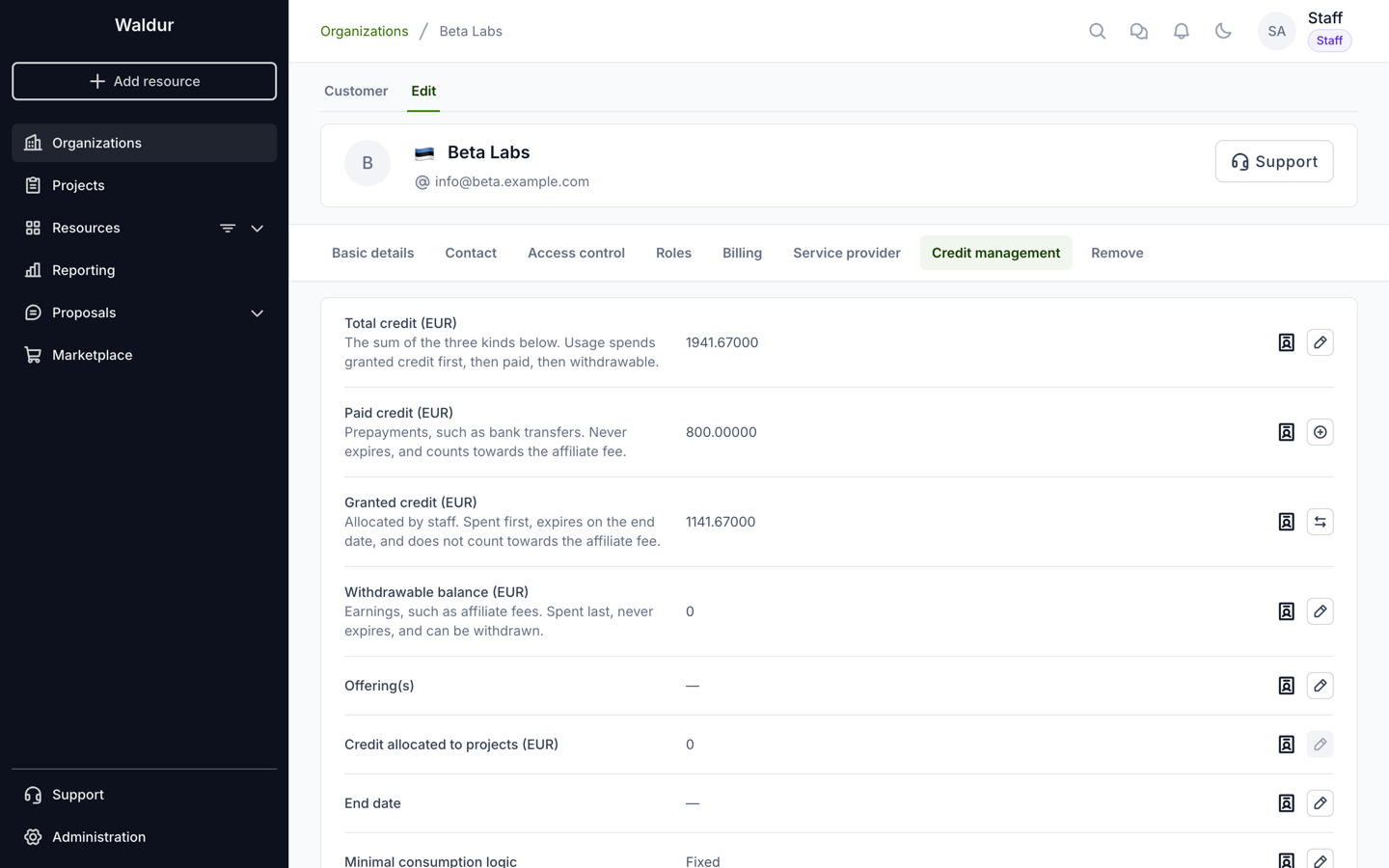
Recording a prepayment
Select Top up in the row's Actions menu, or click + next to Paid credit. An organization without a credit has neither: first create one with the value 0, then top it up.
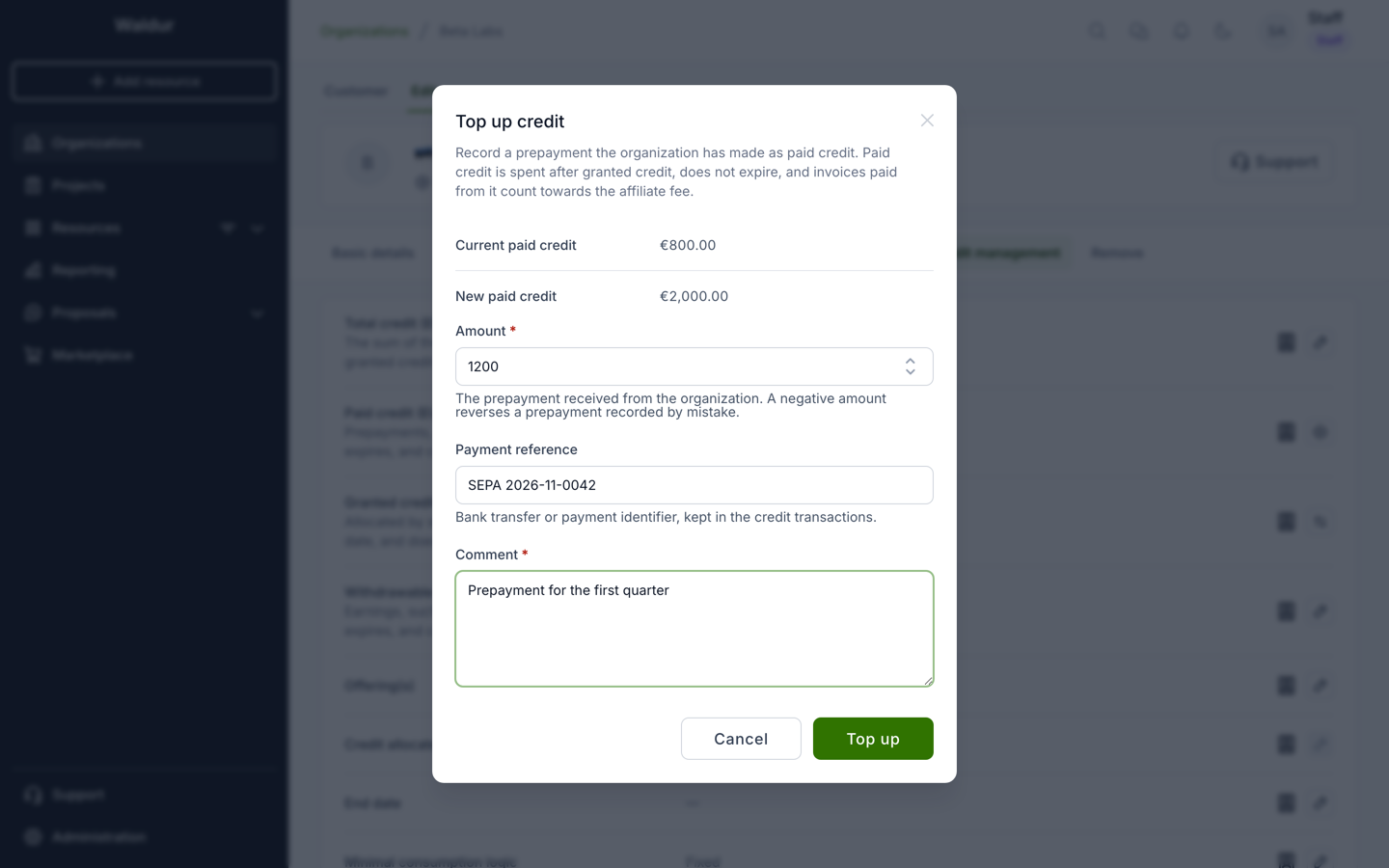
- Amount — the prepayment received. The dialog shows the current paid credit and what it becomes. A negative amount reverses a prepayment recorded by mistake, for example a bounced payment; it cannot be larger than the paid credit.
- Payment reference — optionally, the bank transfer or payment identifier. It is kept in the credit transaction.
- Comment — what the prepayment is for.
Click Top up. The total credit grows by the amount.
Marking granted credit as paid
A prepayment recorded earlier as an ordinary grant is granted credit: it expires and earns no affiliate fee. To correct it, select Reclassify as paid credit in the row's Actions menu, or click ⇄ next to Granted credit. Enter the amount and a comment, then click Reclassify. The amount moves from granted to paid credit, and the total stays the same.
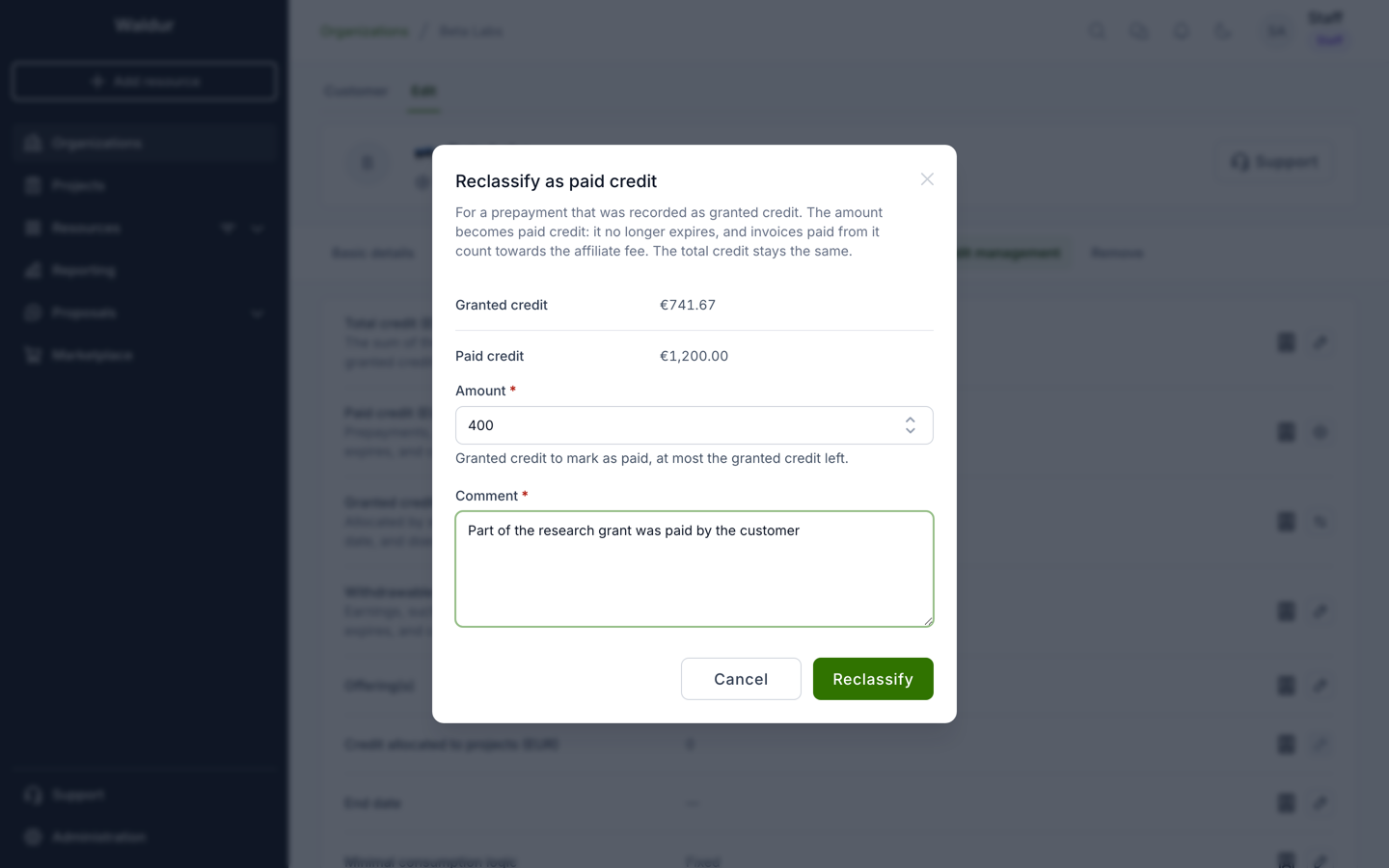
The amount cannot exceed the granted credit left. When none is left, the action is disabled.
Note
Through the API, a top-up is POST /api/customer-credits/{uuid}/top_up/ and a
reclassification is POST /api/customer-credits/{uuid}/reclassify/, each with an amount
and a comment; a top-up also takes an optional payment_reference. Called with a
personal access token, they need the token's STAFF.ACCESS scope.
Paying earlier invoices
Credit pays the month it is used in, so cost of a closed month that no credit covered stays uncovered, however much credit is added later. A project cost policy with the period Total keeps counting that cost and stays over its limit; see Cost policies and credit.
A project credit can also pay that cost. Only staff can set this up, because it changes what the organization was billed for those months. Open the organization, then Accounting → Credit management, open the project credit's actions menu and select Compensation policy.
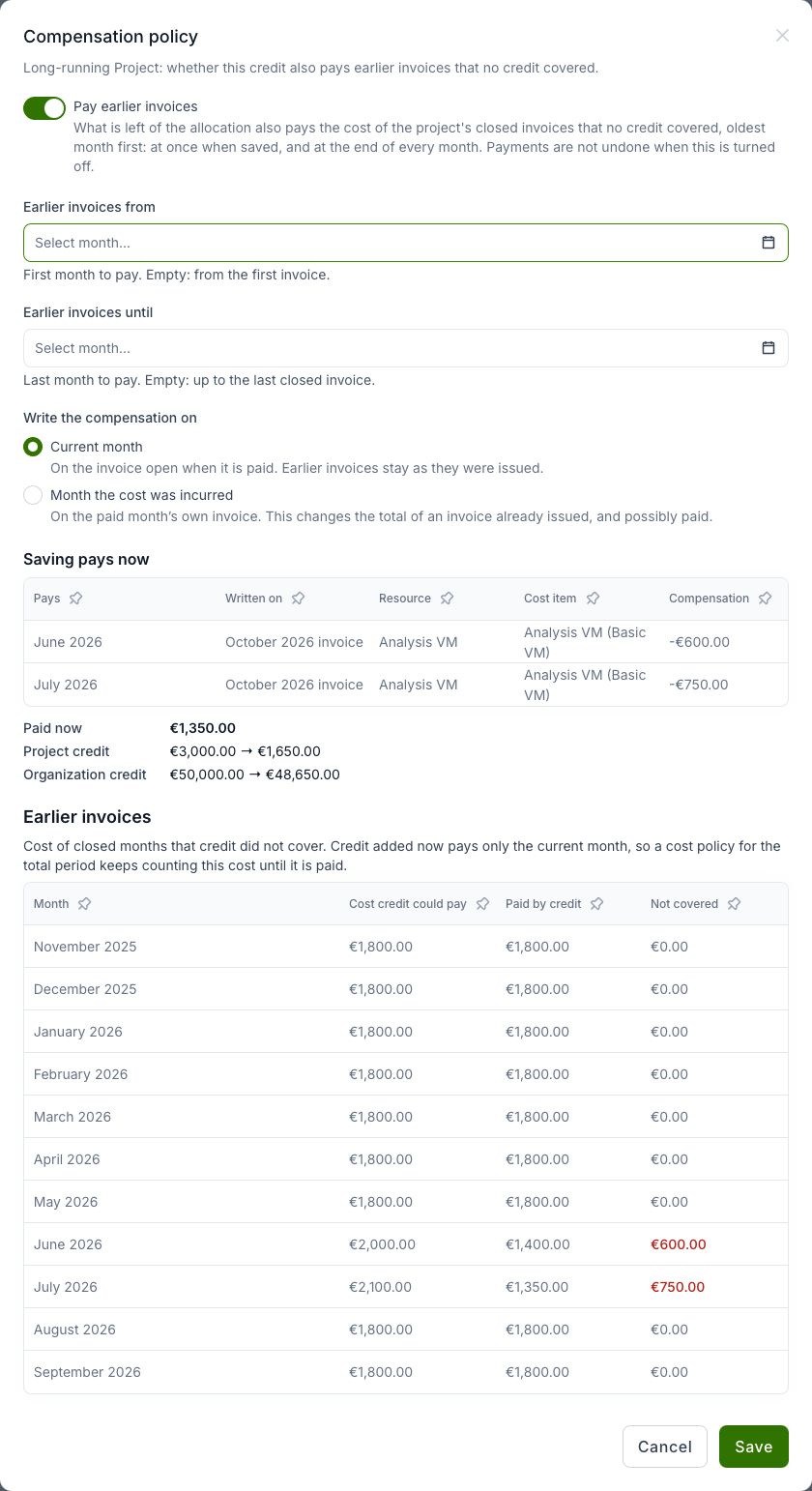
- Turn on Pay earlier invoices.
- Optionally limit the months it pays with Earlier invoices from and Earlier invoices until, both included. Empty means from the first invoice, and up to the last closed one.
- Choose where the compensation is written:
- Current month (the default): on the invoice open when it is paid. Earlier invoices stay as they were issued; the open invoice can go below zero.
- Month the cost was incurred: on the paid month's own invoice. This changes the total of an invoice already issued, and possibly paid.
- Saving pays now lists what saving will pay: each compensation, with the month it pays, the invoice it is written on, the resource and the cost item, and the project credit and the organization credit before and after. The Earlier invoices table below it shows every closed month and what is not covered.
- Click Save.
What the credit pays:
- Closed invoices of the project in the chosen months, oldest month first, on the offerings the organization credit covers.
- Up to the credit available. When saved, that is what is left after this month's usage so far; at the end of every month, what is left after the closing month's own compensation. A later increase of the allocation pays more.
- Each payment is a credit compensation named after the month it pays and the cost item, for example "Credit compensation for 2026-06." followed by the item's name. Cost views and cost policies count it in the month it pays.
Warning
Payments are not undone when Pay earlier invoices is turned off; turning it off only stops further payments. To reverse a payment, adjust the credit.
The same payment can be made from a cost policy: in its Fix… dialog, Pay earlier invoices shows a preview of what will be paid and turns the setting on. See Paying earlier invoices.