Backend ID rules
Waldur lets service providers control the backend ID of resources created from an offering. A backend ID is the identifier a resource has on the provider's backend (for example, the account or project name created on a SLURM cluster). Per offering, you can require this identifier to match a format and to be unique within a chosen scope.
These rules are checked when a backend ID is assigned — when importing an existing backend resource into Waldur, or when setting or changing a resource's backend ID.
The rules are set under Edit → Integration → Backend ID rules.
Configuring the rules
Performed by: Service provider (offering owner)
- Open the offering and select Edit → Integration.
- Open the Backend ID rules card.
- Edit any of the fields below with its pencil button. Each field is saved on its own.
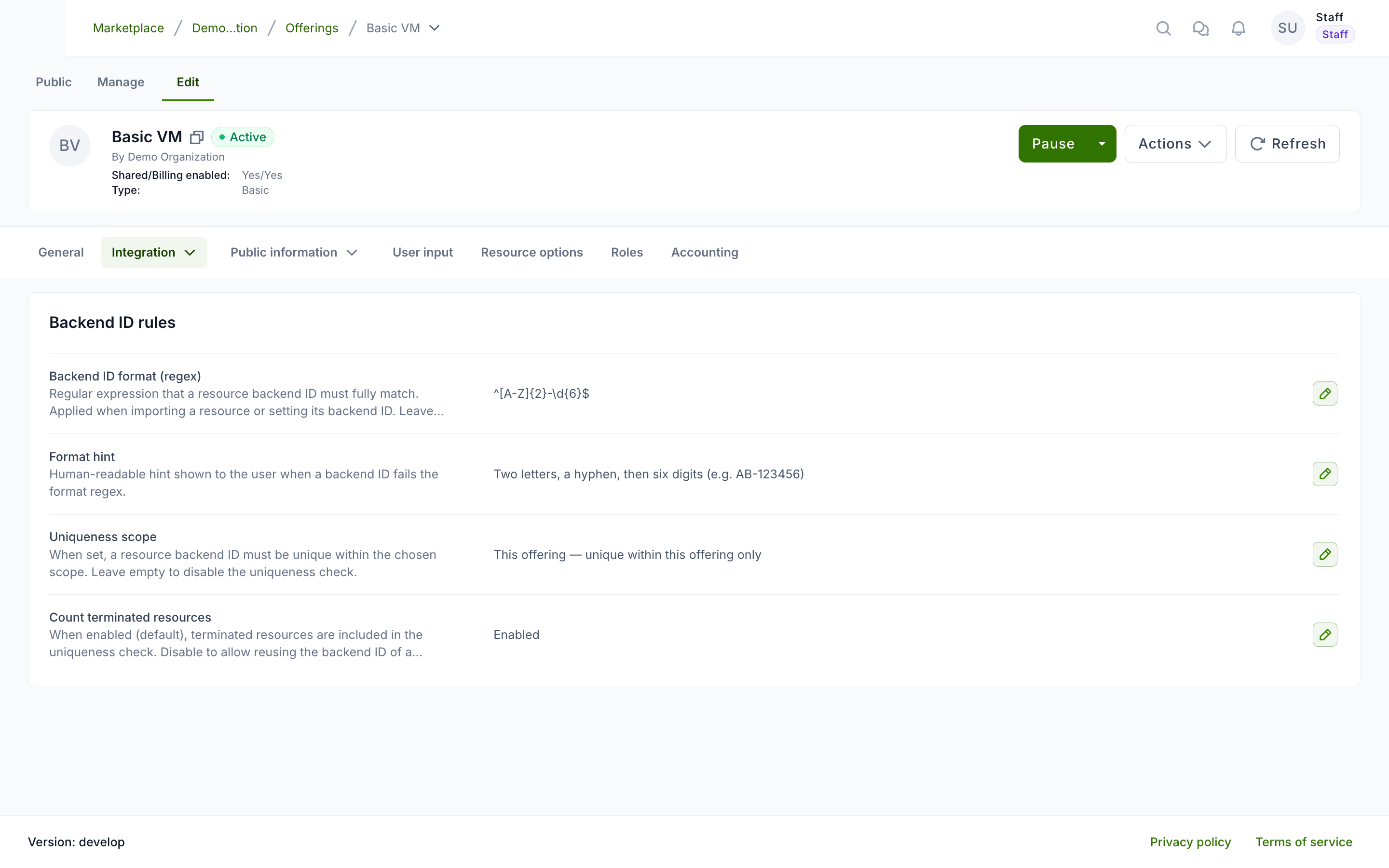
Fields
Backend ID format (regex)
A regular expression that a resource backend ID must fully match. For example, ^[A-Z]{2}-\d{6}$ accepts identifiers such as AB-123456. Leave it empty to allow any value.
Format hint
A human-readable message shown to the user when a backend ID fails the format regex — use it to explain the expected format in plain language.
Uniqueness scope
When set, a resource backend ID must be unique within the chosen scope. Leave it empty to disable the uniqueness check.
| Scope | A backend ID must be unique across… |
|---|---|
| This offering | resources of this offering only |
| Offering group | all offerings that share this offering's backend ID |
| Service provider | all offerings owned by this organization |
| Service provider & category | this organization's offerings in the same category |
Count terminated resources
When enabled, terminated resources are included in the uniqueness check. Disable it to allow a new resource to reuse the backend ID of a terminated one. This applies only when a uniqueness scope is set.
Note
If no value is set, the uniqueness check includes terminated resources by default.
How the rules are applied
- The rules take effect only where a backend ID is assigned: importing a backend resource, or setting/changing a resource's backend ID. Resources without a backend ID are not affected.
- An empty format allows any value; an empty uniqueness scope disables the uniqueness check. The two are independent — you can require a format without uniqueness, or vice versa.
- If the format regex is invalid, the format check is skipped rather than blocking assignment.
Tip
You can also validate a backend ID against these rules before assigning it, using the offering's backend ID check — helpful for catching duplicates or malformed identifiers early.