OpenStack
Waldur integrates with OpenStack-based clouds through a single OpenStack plugin. It provisions and manages OpenStack projects (tenants) together with the compute, network and storage resources inside them, and exposes them for self-service ordering through the Waldur marketplace.
Requirements
OpenStack releases known to work:
- Queens
- Rocky
- Stein
- Train
- Ussuri
- Victoria
- Wallaby
- Xena
- Yoga
- Zed
- Antelope
Newer releases are generally compatible, as Waldur talks to OpenStack through the standard service clients (Keystone v3, Nova, Cinder, Neutron and Glance).
To integrate an OpenStack-based cloud as a shared provider, the following data is required:
- URL of Keystone's public endpoint (v3).
- Network access from the Waldur server to the public interfaces of Keystone, Nova, Cinder, Neutron and Glance.
- Admin credentials (username/password) and the domain name (if a non-default domain is used).
- External network UUID — the network connected by default to the OpenStack projects (tenants) that Waldur creates.
Check a cloud before onboarding it
The OpenStack compatibility check runs every OpenStack operation Waldur performs against your cloud through your Waldur deployment, and reports which ones work. Run it before you onboard a new cloud or after you upgrade one.
Marketplace offerings
OpenStack is exposed to end users through three marketplace offering types:
- OpenStack.Tenant — provisions an OpenStack project (tenant) with quotas for cores, RAM and storage, an internal network, a subnet and a router, and connects it to the external network.
- OpenStack.Instance — provisions a virtual machine inside a tenant.
- OpenStack.Volume — provisions a block-storage volume inside a tenant.
Tenant provisioning options
When ordering a tenant, the following options are available:
subnet_cidr— CIDR of the default private subnet.availability_zone— default availability zone for the tenant.security_groups— security groups to create in the tenant.skip_connection_extnet— do not connect the tenant to the external network.skip_creation_of_default_router— do not create the default router.skip_creation_of_default_subnet— do not create the default subnet.
Offering options
Per-offering settings control how tenants behave:
storage_mode—fixedfor a single storage quota, ordynamicfor per-volume-type quotas.max_instances,max_volumes,max_security_groups— upper bounds enforced within a tenant.default_internal_network_mtu— MTU applied to networks created in the tenant (68–9000).
Default marketplace categories
Two of the three OpenStack offering types have a default category flag on a marketplace category, used when Waldur auto-creates offerings during an OpenStack import:
| Flag | Used for |
|---|---|
default_vm_category |
the category new instance offerings are placed in |
default_volume_category |
the category new volume offerings are placed in |
At most one category may carry each flag; Waldur rejects an attempt to set a flag that another category already holds. Both categories are created automatically, with their flags set, the first time an OpenStack environment is imported — so under normal operation there is nothing to configure.
To set one by hand, go to Administration → Marketplace → Categories in Homeport, open the row's actions menu and choose Edit. The flags are at the bottom of the dialog:
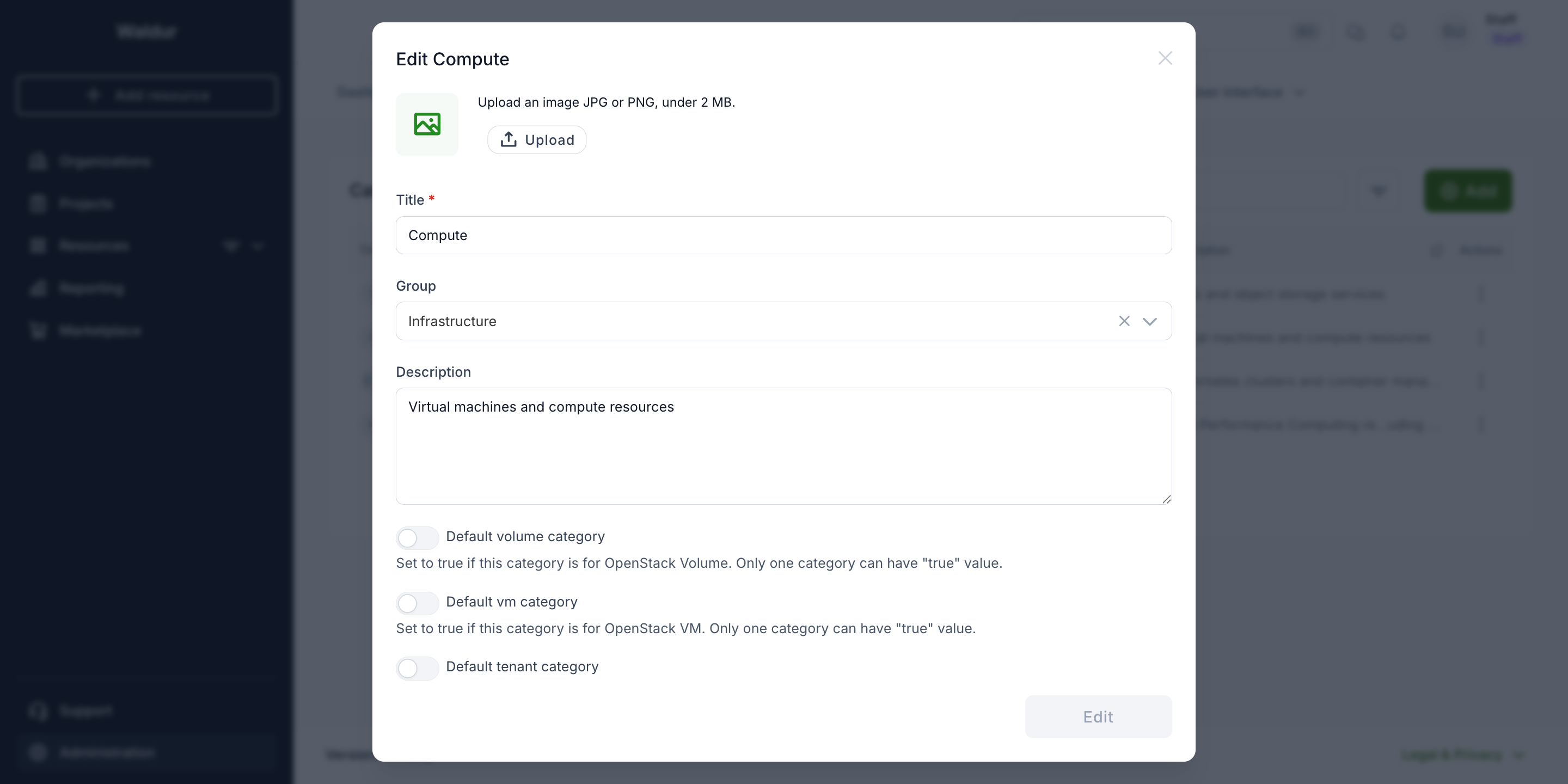
They are also settable through the API as a staff user, and on the category in the Django admin site:
1 2 3 4 5 | |
TENANT_CATEGORY_UUID and friends are not something you need to set
Older releases published INSTANCE_CATEGORY_UUID, VOLUME_CATEGORY_UUID and
TENANT_CATEGORY_UUID under WALDUR_MARKETPLACE_OPENSTACK in the /api/configuration/
response. Nothing has consumed them since 2023, and they are no longer published.
If you are on a release that still shows them, seeing null is harmless — no behaviour depends
on the value. In particular there is no default_tenant_category equivalent to the two
flags above: nothing in Waldur reads that flag, so a null TENANT_CATEGORY_UUID is expected
rather than a misconfiguration to fix.
Supported resources
The plugin discovers and manages the full set of OpenStack resources:
- Compute — instances, flavors and server groups (affinity / anti-affinity, including soft variants). Instances support cloud-init user data, config drive, SSH key injection, multiple network ports and boot-from-volume.
- Networking — networks, subnets, ports, routers, floating IPs and security groups (ingress
and egress rules, TCP/UDP/ICMP, IPv4 and IPv6). Cross-tenant network sharing is supported via
RBAC policies (
access_as_sharedandaccess_as_external). - Storage — volumes and volume types, with resize, retype and boot-from-image. Snapshots and full instance backups are supported, each with a retention period after which they are cleaned up automatically.
- Images and availability zones — images and per-resource availability zones for instances and volumes.
Quotas are enforced and kept in sync at the service, tenant and project levels, and resource state is reconciled with the backend on a periodic schedule.
Billing
Tenant offerings are billed on quota limits using monthly components:
- Cores — vCPU limit.
- RAM — memory limit, in GB.
- Storage — total storage limit, in GB.
In dynamic storage mode, a separate storage component is created for each OpenStack volume
type (for example storage_ssd), so that each volume type can be billed independently.
Organization-specific external networks
A specific external network can be assigned to all OpenStack tenants created by a given organization on a given provider. When a tenant is created, Waldur resolves the external network to connect to in the following order:
- The external network set on the tenant itself.
- The external network configured for the organization on that provider.
- The provider's default external network.
The tenant's default router is then connected to the resolved external network, and the tenant's external network reference is recorded for floating IP allocation.
Networks shared by projects Waldur does not manage
Providers often keep shared networks — a provider LAN, a storage network — in the cloud's
admin project or a service project, and hand them to customer tenants with a Neutron RBAC
policy:
1 2 | |
Waldur picks such a share up on the tenant's next pull, even though the owning project is not a Waldur tenant. The share is discovered from the RBAC policy itself — Neutron does not return networks shared with a project when an admin lists that project's networks.
How it appears. Waldur records the owning project as an unmanaged tenant
(is_managed: false) in a project named <provider> provider networks, under the provider's
organization. Waldur only reads it: it holds no credentials for it, never provisions, bills,
pulls with tenant credentials or deletes it, and refuses every change to it, its networks and
their subnets through the API. Only the networks it shares with Waldur tenants are imported,
together with their subnets.
Each of those subnets carries a tenant_is_managed field saying which kind of owner it has.
It is false for a subnet of a network shared into a tenant from a project Waldur does not
manage, and true otherwise, so an API client can tell a subnet the tenant owns from one it
merely reaches through a share.
What the tenant can do. The shared network and its subnets are listed in the tenant's Networks and Subnets tabs and can be used like the tenant's own:
- VMs can be ordered on the shared subnet, and ports created on the shared network; both belong to the tenant.
- The shared subnet can be attached to the tenant's router, which also lets a VM on it get a floating IP through that router.
- Security groups can be set on the tenant's ports on the network.
Two things stay with the network's owner:
- Sharing. The share can be created, changed or revoked only in OpenStack, not from Waldur.
- Allowed address pairs. Neutron's default policy lets only the network's owner or an administrator set allowed address pairs on a network, so a tenant's request for a port on a shared network is refused, and Waldur reports that refusal.
When the share ends. Revoking the policy (Neutron refuses while the tenant still has ports on the network) removes the network from Waldur on the tenant's next pull; deleting the tenant does the same at once. Once a project shares nothing with any Waldur tenant, its unmanaged tenant is removed as well. Only Waldur's records are removed — the network stays in the cloud.
Note
Wildcard shares (--target-project '*', i.e. networks created with --share) and
access_as_external policies targeted at single projects are not imported this way. External
networks are configured on the offering instead (see above).